
You can save time and money by treating your own plantar fasciitis – Here's how

Updated: Sep 8
Plantar fasciitis is a pesky, painful, and persistent problem, but the good news is that the majority of the most effective treatments identified in the research are all things you can do at home. No having to take time off work and forking out to go and see a physio! This article will give you a complete list of the most effective treatments for plantar fasciitis that you can apply yourself.
Remember, if you need help with an injury, you're welcome to consult one of our physios online via video call.
We might earn a small commission on the sale of some of the products listed on this page at no extra cost to you.
In this article:
Plantar fasciitis treatment: What is the most effective?
The treatment for plantar fasciitis has to be tailored to you. There will never be a single treatment to cure plantar fasciitis, simply because there can be so many different reasons why you develop heel pain.
The plantar fasciitis treatments below can be roughly divided into treatments that reduce pain and help support the injured area, and treatments that strengthen the plantar fascia.
The most effective treatments according to the research are:
(see details under each section)
⭐ Relative rest
I've given relative rest a gold star because it is one of the most important components of treatment and the only one that every person with plantar fasciitis should apply.
Once injured, your plantar fascia loses some of its strength and endurance. So now it struggles to cope with the load you place on it when you do your normal daily activities and sport. If you try and ignore the pain and just continue as normal, it usually just gets worse.
Remember, your plantar fascia supports your foot's arch and has to work whenever you stand, walk, run, or jump. To allow it time to recover, you have to reduce these activities to a level that does not cause your pain to increase significantly.

Complete rest is not needed nor is it useful, as it can cause your foot to lose more strength.
You just have to limit the time you spend on your feet to what your foot can currently tolerate.
👉 So, observe how your pain reacts to the time you spend on your feet standing, walking, etc., and then temporarily limit your activities accordingly.
💡 Wearing good shoes and orthotics can reduce the strain on your plantar fascia and help your foot tolerate more activity. I discuss what to look out for in this article.
Stretching for plantar fasciitis
The calf muscles are connected to the plantar fascia via a fascia extension from the Achilles tendon, and I always find that they are tight in my patients who complain of heel pain.
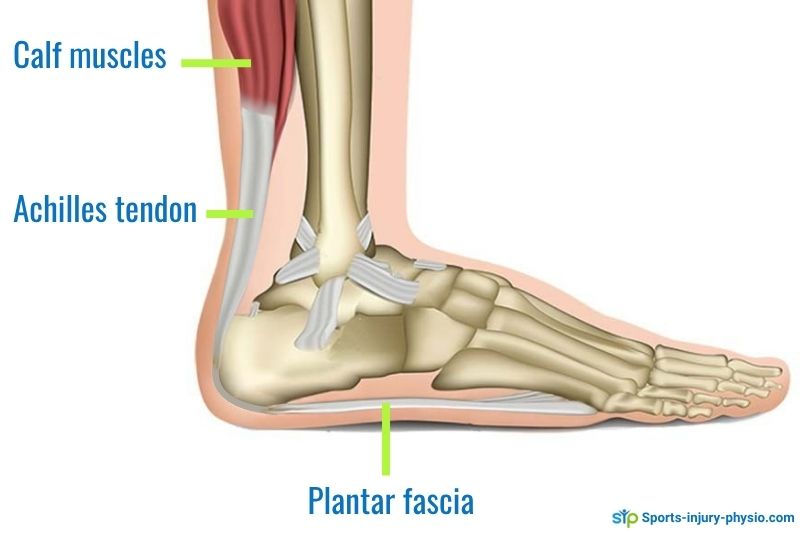
Actually, all the muscles in the back of your leg are connected. This is why you should not only include stretches for the plantar fascia but also for the rest of the leg and back.
👉 A word of caution – you can make the symptoms worse if you over-stretch. Find a detailed explanation and demo of what stretches you should do for plantar fasciitis here.

Strengthening exercises for plantar fasciitis
The shape of the foot is determined by a passive support system (bones, ligaments, plantar fascia) as well as an active one (muscles and tendons). The plantar fascia is put under extra strain if the muscles in your foot and lower leg are weak or they cannot control your foot properly.

👉 Strengthening and proprioceptive exercises can be very effective in the treatment of plantar fasciitis, but it is important that you do them at the correct intensity for the stage of your recovery.
Massage for plantar fasciitis
It is easy to massage your plantar fascia as well as your calf using massage balls and foam rollers. The current research suggests that foam roller massage can be just as effective as a massage from a therapist when it comes to pain relief and increasing muscle length.
👉 Massage for plantar fasciitis should include all the muscles along the back of your legs – not just the plantar fascia. I've created a detailed article with demo videos of how to massage yourself for plantar fasciitis.

Taping for plantar fasciitis
There are several taping techniques that you can try. The one thing that they all have in common is that they try and off-load the plantar fascia through supporting the inside arch of the foot and preventing the foot from rolling inwards excessively when you step on it.
One of the most commonly used is the Low Dye Taping technique. You can watch my variation of this technique below.


Orthotics or supportive insoles for plantar fasciitis
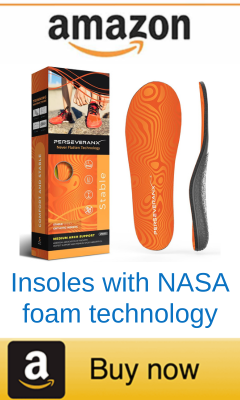
Foot orthotics come in various shapes and levels of support. I usually prescribe a medium density off-the-shelf orthotic that supports the inner arch of the foot.
💡 This reduces the load on the plantar fascia and gives it a chance to recover. Think of it as a "crutch" for the plantar fascia.
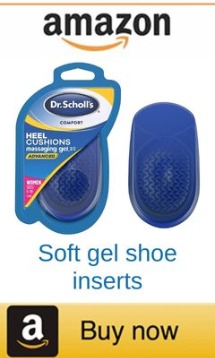
However, some people find that the pressure from the arch support actually irritates their foot more. If this happens, then soft gel inserts may be useful.
The gel inserts don't support the arch but some patients seem to benefit from the extra cushioning under the heel. There is some research that shows that people with plantar fasciitis often also have a thinner fat pad (so less cushioning) under their heel bone - the gel insert may help with this.
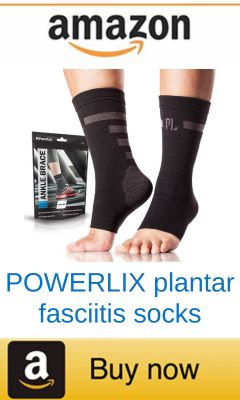
I’ve selected the products below from Amazon, as they are similar to the ones we use in our clinic and appear to be good value for money.

Shoe selection for plantar fasciitis
Unsupportive and inflexible shoes provide very little arch support and put a much greater strain on the plantar fascia.
While shoes with good cushioning and arch support reduce the strain and help your pain calm down.
👉 Shoes are such an important part of treatment that we've created a detailed article about this - we explain why it might be a good idea to mix up the types of supportive shoe you're wearing, why these shoes don't have to look boring or ugly (with links to ones our patients find useful), and how even minimalist shoes might play a role in your rehab.

Night splints for plantar fasciitis
When we sleep, our feet naturally drop into a pointed-down position (plantar flexion). In this position, the plantar fascia can tighten overnight as circulation slows while you lie still. When you then step on it, the sudden stretch through the irritated tissue can cause quite a lot of pain.
💡 Night splints aim to prevent this by keeping the plantar fascia in a slightly lengthened position during the night, reducing that sudden stretch and easing pain in the morning.
👉 In my experience, not everyone needs them, but I find them effective in patients with persistent symptoms.
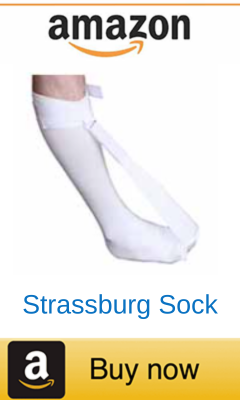
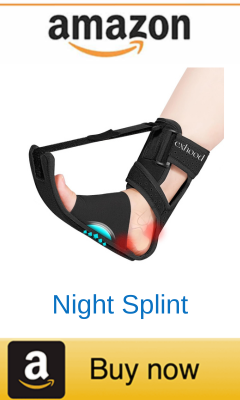
Night splints come in various shapes and range from very rigid to soft. I prefer the Strassburg sock for comfort, but I’ve also included an example of a more rigid splint with an arch cushion below.
TENS for plantar fasciitis
TENS has been shown to reduce pain while you're hooked up to the TENS unit and maybe for a few hours afterwards. But there isn't convincing evidence that it is a treatment method that will speed up your healing.
So, TENS can be useful to reduce intense plantar fasciitis pain to enable to you carry on with a treatment method that will eventually heal you. Read more about TENS treatment and how to apply it for plantar fasciitis.
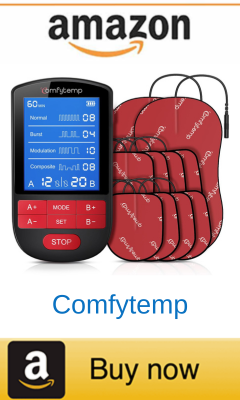
These three TENS units come with electrode pads small enough to stick securely even on small feet.


Shockwave
This is not a self-treatment option and should be administered by a trained clinician.
The research suggests that shockwave therapy (sound-pressure pulses aimed at the injured area) can reduce plantar fascia pain and improve recovery.
💡 However, the current recommendations are that shockwave should only be used for plantar fasciitis that has lasted longer than three months and isn't recovering as expected.
👉 Here's our article with much more detail on the use of shockwave treatment for plantar fasciitis.
Red light therapy for plantar fasciitis
Red light therapy might help to reduce pain, but you have to get the settings on your device right if you do this yourself. 👉 Here's our guide to red light therapy.
Weight loss
The less you weigh, the less force is transferred through your plantar fascia when you stand, walk, or run.
However, this does not mean that the skinnier you are, the better – losing weight is unlikely to benefit you if you're already within a healthy range. Being underweight usually leads to poorer healing and can cause a host of overuse injuries, including plantar fasciitis.
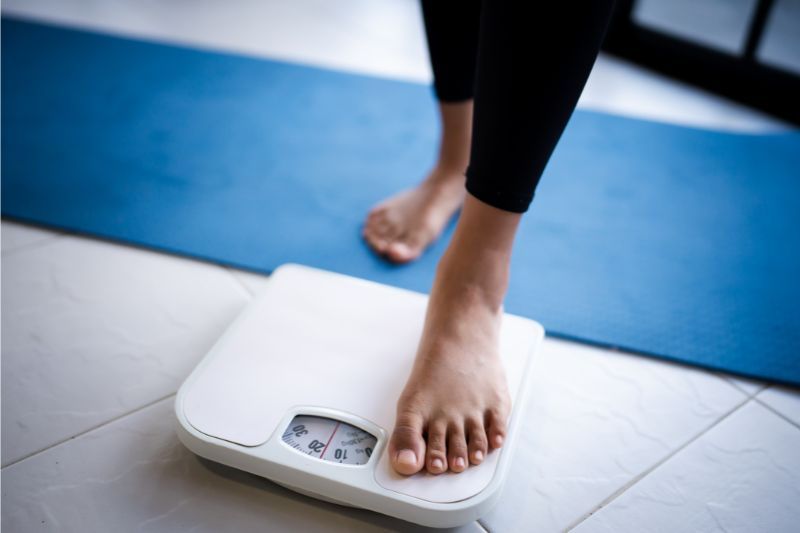
If you are carrying a few extra pounds, losing them may help. But weight loss takes time, so focus on getting the other factors right (relative rest, shoes, insoles, etc.) while you work on it.
Treatments that don't work for plantar fasciitis
It’s common to reach for anti-inflammatories when plantar fasciitis becomes very painful, but they’re unlikely to be helpful in most cases.
That’s because plantar fasciitis isn’t primarily an inflammatory injury. It’s an overuse problem – the plantar fascia becomes irritated and loses some strength when it’s repeatedly overloaded.
There may be a small amount of inflammation in the early stages, when your foot first becomes painful, or during a sudden flare-up. However, this inflammation is usually part of the normal healing response and doesn’t need to be suppressed.
💡 It’s only worth considering anti-inflammatories for a short period if your pain is severe or you have clear signs of excessive inflammation – such as redness, swelling, heat, or throbbing.
If your symptoms have been present for more than three months, anti-inflammatories are unlikely to make a meaningful difference, as research shows there is very little inflammation in longer-term cases.
Physiotherapists sometimes use ultrasound treatment on plantar fasciitis, but the research also don't support this.
Other articles in the plantar fasciitis treatment series:
Self-treatment – overview of the treatment options (this article)
Good (and stylish) shoes for plantar fasciitis – A physiotherapist’s guide
How we can help
Need help with an injury? You’re welcome to consult one of the team at SIP online via video call for an assessment of your injury and a tailored treatment plan.

We're all UK Chartered Physiotherapists with Master’s Degrees related to Sports & Exercise Medicine. But at Sports Injury Physio we don't just value qualifications; all of us also have a wealth of experience working with athletes across a broad variety of sports, ranging from recreationally active people to professional athletes. You can meet the team here.


About the Author
Maryke Louw is a chartered physiotherapist with more than 20 years' experience and a Master’s Degree in Sports Injury Management. Follow her on LinkedIn and ResearchGate.


